The Plight of California’s Prisons: Hunger Strike, Sterilization and Valley Fever

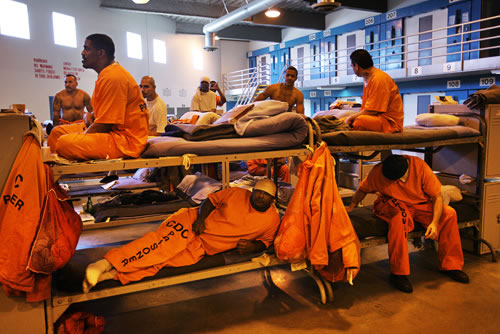
It's been all over the papers and many bloggers are tackling the horrendous conditions in California. A prison system that in 2011 was ordered by the Supreme Court to figure out what to do with 30,000 people who because of the system's overcrowding were suffering "cruel and unusual punishment." As Laura Gottesdiener wrote in the Huffington Post , "The state’s 140,000 inmates, jam-packed into 33 prisons only built to hold 80,000 individuals…commit suicide at double the national inmate average, experience unprecedented rates of lock-downs, receive inadequate medical treatment and sometimes live in continuous fear of violence."

image from thebusysignal.com

In early July, the infuriating news broke that between 2006-2010, doctors who were under contract with the California Department of Corrections and Rehabilitation (CDCR) sterilized nearly 150 female inmates without anyone's approval. Corey G. Johnson, writing for The Center for Investigative Reporting wrote that these doctors were paid $147,460 to perform the procedure that "at least 148 women received tubal ligations…during those five years – and there are perhaps 100 more dating back to the late 1990s, according to state documents and interviews."

And it doesn't get better for prisoners, or for that matter, for any of us who care about how we treat those behind bars. California holds nearly 12,000 people in solitary confinement at a cost of over $60 million per year. The prisoners recognize that they have committed crimes but they are suffering under extreme isolation. U.S. News and World Report called these cells "living tombs." I wrote about Massachusetts' current attempts and need to get rid of these dangerous solitary conditions recently online at Boston Magazine.

On one of the best websites about their plight, Prisoner Hunger Strike Solidarity says about California's Secure Housing Unit (SHU), "The cells have no windows, and no access to fresh air or sunlight. The United Nations condemns the use of solitary confinement for more than 15 days as torture, yet many people in California state prisons have been encaged in solitary for 10 to 40 years."

The hunger strike began on July 8th when more than 30,000 prisoners in 15 prisons refused meals. As reported on Democracy Now, as they entered their 13th day, about 2,500 prisoners from across the state were still on indefinite hunger strike, calling for Governor Jerry Brown and the CDCR to meet their demands about the inhumane conditions they are suffering. But as Lois Ahrens of the Real Cost of Prisons Project said in an email, California officials are trying in any way they can to discredit the strike. Brown has not been moved to act. Strikers' lawyers are not being allowed into the prisons. Soon it will be into the third week.

Jules Lobel, president of the Center for Constitutional Rights and lead attorney representing Pelican Bay prisoners in a lawsuit challenging long-term solitary, appeared on Democracy Now.  said  "If you’re found guilty of murdering somebody in prison, you’re given a definite term, which can be no more than five years in solitary. If you, on the other hand, are simply labeled by some gang investigator as a member of some gang—and that could be done simply because you have artwork or because you have a tattoo or because you have a birthday card from somebody who’s in a gang, anything like that—you then are given an indefinite sentence, which can go on for years and years and years and decades."

This is not the first hunger strike for California. In 2011, over 12,000 prisoners and their family and community members participated in statewide hunger strikes protesting the inhumane conditions in solitary.  The core demands for the current strike, one of the largest  ever, are below, in their own words from the Prisoner Hunger Strike Solidarity website.

  1. End Group Punishment & Administrative Abuse
  2. Abolish the Debriefing Policy, and Modify Active/Inactive Gang Status Criteria -Perceived gang membership is one of the leading reasons for placement in solitary confinement. The practice of “debriefing,” or offering up information about fellow prisoners particularly regarding gang status, is often demanded in return for better food or release from the SHU. Debriefing puts the safety of prisoners and their families at risk, because they are then viewed as “snitches.”
  3. Comply with the US Commission on Safety and Abuse in America’s Prisons 2006 Recommendations Regarding an End to Long-Term Solitary Confinement – (my note– Why is this not so???)
  4. Provide Adequate and Nutritious Food –
  5. Expand and Provide Constructive Programming and Privileges for Indefinite Secure Housing Unit (SHU) Status Inmates.

While this strike rages on, another horrible plague has struck California's prisoners. While Governor Brown has said that California has the greatest health care for prisoners "in the world," San Francisco Bay View reported that over 3,300 prisoners in such facilities as Avenal and Pleasant Valley State Prison are at high risk of infection or death from valley fever. Since 2006, 62 behind bars in California have died from this disease which undoubtedly is related to overcrowding and other unhealthful conditions. And 80% have been African-American, reported the Bay View.

Many have joined rallies and protests and signed petitions– all found at the websites I've mentioned above. However, while we complain of 100 degree heat and take solace in our air conditioned homes, prisoners are suffering — and not just for their crimes.

Parole in Massachusetts: NOT!

Look at these dismal figures about parole in Massachusetts: " In 2010, the board granted parole to lifers 33.1 percent of the time; in 2012, 19.3 percent of the time; and as of May 25, 2013, only 14.3 percent of the time." And here's why:

In 2011, Deval Patrick made a mistake.

My new article in Boston Magazine's July issue, and online "Locked Up with Nowhere to Go"
 

Juveniles are not Adults

Please see my new post on Boston Magazine's about sentencing 17 year-olds as juveniles instead  of as adults and housing them with adults in jails, prisons and other lock-ups.

Here's how it begins: "When it comes to incarceration, Massachusetts has recognized 17 as the age of adulthood since 1846. Of course, anyone who has a 17-year-old might question that assumption, as have citizens in 38 states across the U.S. Even some states we think of as far more conservative than Massachusetts—Arizona, Alabama, and Mississippi, for example—send lawbreakers younger than 18 to juvenile instead of adult court.

In May, the Massachusetts House of Representatives voted unanimously that most 17-year-olds could no longer be tried and sentenced as adults…"

The Attempt to Censor What Prisoners Read

Just after writing my blog last week about the wonders of Changing Lives Through Literature (see "What You Need to Know About Changing Lives Through Literature") I came across an article on the Christian Science Monitor (CSM) titled "Should prison inmates be allowed to read whatever they choose?"

We know prisons only let in paperback books. At least that is what Framingham Women's Prison told me some years ago. But they also certainly don't want books critical of their practices and wouldn't house my book, Shakespeare Behind Bars in the prison library when it was first published. They said it was because it was a hardback but even in paper, I've heard it hasn't made its way there.

Husna Haq, in his CSM article mentions that recently the 1st District Court of Appeal in San Francisco overturned a previous ruling barring a prisoner from receiving a book he requested deemed "problematic" by prison officials. The book in question was The Silver Crown by Mathilde Madden "which has widely become known as 'werewolf erotica,' and was considered too sexual by corrections officers."


What? Corrections Officers are deciding that a book is too sexual for prisoners to read?

Get a load of this other recent news article posted in Business Insider. Called "America's Prison Guards Are The 'Ugly Stepchildren' Of The Criminal Justice System" the article reveals how guards "allegedly snuck cellphones and other contraband to Black Guerrilla Family (BGF) prison gangsters." They allowed them to do whatever they wanted apparently, and BGF leader Tavon White is accused of impregnating four guards, two of whom got tattoos with his name.

Thankfully, as Salon reported, the Court found that the prison had overstepped its bounds in the case, engaging in an “arbitrary and capricious application of the regulation.” The judge declared that " The Silver Crown did not meet the famous 'three-pronged' standard by which American courts have determined obscenity since the Supreme Court of the United States’ decision on Miller v. California in 1973."

A 2011 suit by the American Civil Liberties Union charged a South Carolina prison with denying its prisoners all reading material other than the Bible.Other cases include an Alabama prison that barred a prisoner from reading the Pulitzer Prize-winning Slavery by Another Name: The Re-Enslavement of Black Americans From the Civil War to World War II by Douglas Blackmon.

Why, because it was too controversial? That's what I was told at Framingham when I wanted to teach a June Jordan essay and direct a version of Zora Neale Hurston's Their Eyes Were Watching God. Way before Oprah produced a movie in this novel, I had planned to have many Janies and the focus on a re-creation of the trial scene. But the prison said that involving my theatre troupe in such an effort was "too racial." And I quote.

The truth is that prisons want to control behavior. They want to "reform" which usually means to turn out people who are as conformist as possible. Read, write fine. As long as they don't overstep "our boundaries."

The idea that freedom of the press or the freedom to read literature of one's choice doesn't exist for prisoners is unconstitutional. The idea that is does is illusion.

Male Guards Strip Searching Women in Jail

Not that this surprises me. I worked at Framingham Women's Prison in Massachusetts in the 1990's when male guards rounded up women in the middle of the night for an "alleged" strip-search. They were sued. The women won. But the extent of the case at the jail in Chicopee where Sheriff Michael J. Ashe is reputed to be innovative, concerned and on the side of the women is frankly appalling.

This image of a woman strip searched by a female guard via ACLU. It's humiliating enough, right?

The story broke on May 23rd on a local TV station in the western part of the state,WWLP, and was picked up the next day by the The Springfield Republican but the suit was originally filed in September 2011. At that time, Debra Baggett, a former prisoner at the Western Mass Regional Women’s Correctional Center sued on behalf of 178 women. It took a while — what's new? — but U.S. District Judge Michael A. Ponsor has finally ruled that the class action suit can go forward. 178 women, strip-searched at different times, were allegedly videotaped by a male officer during those body-cavity searches. These were women segregated from the population for different reasons such as suicide watch; the jail claimed that strip searches were necessary for safety per attorney David Milton, interviewed on the Bill Newman radio show, also out of Western Mass.

WWLP reported that Boston Civil Rights attorney Howard Friedman, colleague of Milton, said these travesties occurred between 2008 and 2010, and that "men held the camera for 71% of the videotaped strip searches." Attorney Friedman also asserted, says WWLP that after prison officials became aware of the lawsuit in 2012, the percentage of those videotaped dropped to 2% by 2012.

Where was Sheriff Ashe, the innovator during all this? One can only speculate.

These cases are so clearly an abuse of power that it is almost not worth mentioning the obvious. And yet a woman stripped naked in front of male officers should only occur in cases of emergency. Female officers should always be conducting searches. And it shouldn't take a lawsuit to change an abusive policy. Supposedly the jail now only videotapes when they feel there is a direct threat, i.e. dangerousness, but I bet they aren't letting men hold the camera now. Plus, why on earth we need videotaping of people who might commit suicide when they are being strip searched — for contraband supposedly –is beyond beyond.

In 2011, The 9th Circuit Court of Appeals ruled that cross-gender strip searches of prisoners were unconstitutional, reported in the ABA Journal of the American Bar Association. That was when a male sued because a female officer searched him.

A court is expected to rule on whether the policy that was allegedly in place at the women's correctional center was or was not constitutional. That's to happen sometime in early 2014. Let's hope the next judge does the right thing.