Prisoners Find Meaning in Posting Art Online
Check out my new blogpost about the art prisoners create and post on blogs at:

The second of the three part series. Boston Daily
Check out my new blogpost about the art prisoners create and post on blogs at:
The second of the three part series. Boston Daily
Some pretty amazing theatre work is happening outside Chicago at the Illinois Youth Center in Warrenville. There, dynamo Meade Palidofsky spearheads a program that serves young incarcerated women. It's an outlet, a vehicle, a chance to experience their creative selves and break out of their bonds through writing and performing songs, poems, stories and scenes inspired by their personal experiences.

In a program called "Fabulous Females," Storycatchers participants meet twice a week joined by teaching artists, volunteers, and members of the Chicago Symphony Orchestra (CSO) form collaborative groups with the girls. Yes, you read that correctly: THE CHICAGO SYMPHONY ORCHESTRA! So, imagine you are an incarcerated girl and a professional artist gives you their time– well, it helps — and in spite of all the losses and pain behind bars, the horrendous whirlwind that encompasses them daily, these young women find a supportive structure to create composite characters, outline and create a musical play.
And guess who performs along side them in their showcases? Yep, the Chicago Symphony. On the website above there is actually a photo of Yo Yo Ma helping the performers.
Storycatchers's newest musical, "Finding Asia," was recently featured in The Chicago Tribune. It is the story of a girl who is released into her grandmother's care, and after an argument, runs away with her pet rooster to find a new boyfriend whom she met on Facebook. She discovers that he is not who he pretends to be. . For starters, he's 35. She finally comes to grips with the fact that she must choose between a "high-risk, drug-fueled partying and life within the strict but safe confines of her grandmother's home. Asia chooses her family."
Pianist Myron Silberstein from the Civic Orchestra of Chicago, the training ensemble of the CSO composed and arranged the score for himself and three other musicians. They perform live as the cast acts in front of them.
This play reminds me a bit of one I directed at Framingham Women's Prison called Simply Maria by Josefina Lopez. It tells the story of Maria, a young, precocious Latina who comes from Mexico with her family to the U.S. She aspires to be an actor, and her dream is to go to college — something her parents never had.. She too has to give up something on her journey to find herself, in this case, it is what her parents and the church want for her — a typical American dream. Maria finally realizes that college will help her be free, economically independent of men and lead to the life that she wants, a family and a career.
There is a picture of the cast of Simply Maria and a picture of Meade's Storycatchers is this amazing video of Performing New Lives.
Storycatchers Theatre Focuses on Fabulous Females Read Post »
New post on Prisoner Blogs at Boston Daily. What they're saying might surprise you. This is the first of a three-part series.
Can you imagine teaching Shakespeare to men in solitary confinement? And by that I mean men who are actually locked in 23 out of 24 hours a day behind metal doors with only a slit to see through into the hallway? And along with that, try picturing a woman who sits in that hallway, coaching those men as they speak Shakespeare's lines aloud talking to other men who they cannot see?
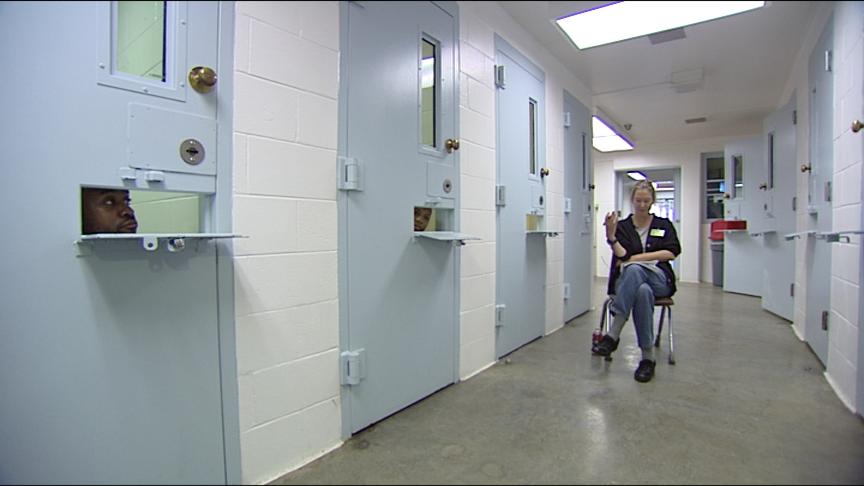
This is the mission of Laura Bates, an amazing woman who is an associate professor at Indiana University and in 2003 began teaching in Wabash Correctional in Indiana. In an article for an Indiana State U publication, Bates says "We are the only Shakespeare program in the segregated unit in solitary confinement anywhere in the world….Never before attempted….never duplicated either."
The process according to the article: "Two officers escort each man into an individual cell in a separate unit inside segregated housing. Bates, as shown above, sits in the small hallway between eight individual cells with the imprisoned men sitting behind metal doors peering, talking and listening through open rectangular cuff ports."
I met Laura Bates when we presented together along with others who had used Shakespeare behind bars and I was knocked out by her work. She has a book coming out in April: Shakespeare Saved My Life: Ten Years in Solitary With the Bard , so hopefully we'll all be able to read more about her and understand this work. She focuses on one particular prisoner and hence the title. Larry felt Shakespeare saved his life.
The men Laura encounters have committed violent offenses behind bars, and thus they are sent to solitary; some have committed horrible crimes. But no prisoner is only their crime. Laura's work points up the idea that to label people us un-redeemable belies their humanity. They are not "the worst of the worst" as often referred to in article after article. They are men who are also human beings indebted to the chance to turn their pain, loss, rage and deprivation into words. Bravo Laura.
If you haven't heard of Amie Dowling, once you see her short film, Well Contested Sites, you won't forget her. Why? She creates dance pieces with formerly imprisoned men and women that touch on all their pain, hopes and dreams, and in addition, raises awareness about issues of incarceration. I have posted the link for her piece here.
Amie's dance background is thoroughly embedded with social justice. She's worked in Thailand with NGO's, assisting women leaving the sex trade industry and developed and toured theatre/dance pieces that addressed what she felt were the underlying issues of prostitution: "class, race, gender inequity, and geographic isolation."
It was her nephew's involvement with gang activity and his subsequent incarceration that drew Amie to found the Performance Project, and from 2001-2008 she created amazing theatre/dance pieces on the East coast with prisoners, presented behind bars to an audience including prisoners and their families.
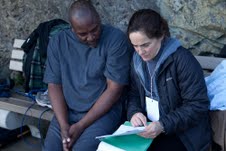
Now she's in California. Here's Amie working with Reggie from her current piece which follows a group of male prisoners as they make their way through the transition from incarceration to life on the outside. This 13 minute film was actually created at Alcatraz and several of the cast members were formerly behind bars. Amie says about the piece's title that it "stems from the idea that a prisoner’s body is a contested site, its presence or absence, its power and its vulnerability are all intensely realized in jails and prisons – institutions that emphasize control, segregation, solitude and physical containment."
I first heard of Amie's work through Jonathan Shailor's book about theatre and dance practitioners in prison, Performing New Lives and in the video Jonathan made to give people a flavor of the book, there is the most stunning picture of male dancers. I might have thought Balanchine. I might have thought a New York stage. The bodies are arched and angled and look trained and dynamic. The feeling is of reaching for freedom and it's apparent in every sinewy muscle. Amie's website is www.amiedowling.com. And her facebook page about the project is here.
In Shakespeare Behind Bars, I wrote that art has the power to show us and those who dwell inside that prisoners are not "damaged goods." Through their transcendence into a world without words, where images speak above all else, they bypass –for if only a shining moment–those they've hurt, the bars that keep them confined and through art, they recognize that they can soar again.