Independence Day in Prison

Today, in honor of our freedom, I'm posting poems from prisoners who aren't, or at one time, were not free.

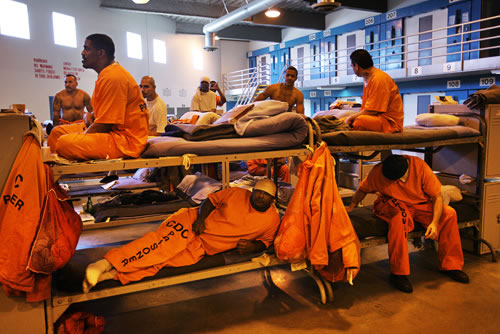
image from the University of York, UK

-Institutionalized-

As a female prison employee walks pass
I inhale and hold
arrested in my lungs her perfume
which reminds me of
freedom.

–Roland F. Stoecker Jr. 3/27/13 posted on Between the Bars


Pictures of a Daughter, Viewed in Prison

You set the photos down,
spreading time around you panorama-style.
Button-nosed baby, toddler, little girl, bigger girl:
Your eyes roam the chain of living paper dolls,
the side-by-side smiles posed just for you.
Time cannonballs you in the gut.
You think, When the hell did all this happen?
How did I miss so much?
Too late to cry, too late to mourn
the baby smell, the small heft, the music of her giggles.
The middle photos blur, become
the space between your first photo and your latest.
This is the abyss into which time has fallen.
Your reverie broken,
you gather up your painful collection and rise.
The clock reads 2:28.
Time has just stolen another hour.

—Christina Snow,  published in I'll Fly Away edited by Wally Lamb and posted on Oprah's website


Sequoia

Bark a mile thick and tough as anything you’ve seen
No sap in this old tree
The wind and fog know better than to venture near
Lest they be swallowed
I strip the fetid earth of all that is good in it
And cast my shadow on all that come near
I am invincible
Indestructible
Beyond reproach
For no one dares to challenge me
The lion of the forest
They’re smart for that
Because they do not know of what I’m capable
Neither do they know
That it is lonely when
There are no arms large enough to hold you
In their embrace

–Karter Kane Reed, in a letter to me

Parole in Massachusetts: NOT!

Look at these dismal figures about parole in Massachusetts: " In 2010, the board granted parole to lifers 33.1 percent of the time; in 2012, 19.3 percent of the time; and as of May 25, 2013, only 14.3 percent of the time." And here's why:

In 2011, Deval Patrick made a mistake.

My new article in Boston Magazine's July issue, and online "Locked Up with Nowhere to Go"
 

Juveniles are not Adults

Please see my new post on Boston Magazine's about sentencing 17 year-olds as juveniles instead  of as adults and housing them with adults in jails, prisons and other lock-ups.

Here's how it begins: "When it comes to incarceration, Massachusetts has recognized 17 as the age of adulthood since 1846. Of course, anyone who has a 17-year-old might question that assumption, as have citizens in 38 states across the U.S. Even some states we think of as far more conservative than Massachusetts—Arizona, Alabama, and Mississippi, for example—send lawbreakers younger than 18 to juvenile instead of adult court.

In May, the Massachusetts House of Representatives voted unanimously that most 17-year-olds could no longer be tried and sentenced as adults…"

The Attempt to Censor What Prisoners Read

Just after writing my blog last week about the wonders of Changing Lives Through Literature (see "What You Need to Know About Changing Lives Through Literature") I came across an article on the Christian Science Monitor (CSM) titled "Should prison inmates be allowed to read whatever they choose?"

We know prisons only let in paperback books. At least that is what Framingham Women's Prison told me some years ago. But they also certainly don't want books critical of their practices and wouldn't house my book, Shakespeare Behind Bars in the prison library when it was first published. They said it was because it was a hardback but even in paper, I've heard it hasn't made its way there.

Husna Haq, in his CSM article mentions that recently the 1st District Court of Appeal in San Francisco overturned a previous ruling barring a prisoner from receiving a book he requested deemed "problematic" by prison officials. The book in question was The Silver Crown by Mathilde Madden "which has widely become known as 'werewolf erotica,' and was considered too sexual by corrections officers."


What? Corrections Officers are deciding that a book is too sexual for prisoners to read?

Get a load of this other recent news article posted in Business Insider. Called "America's Prison Guards Are The 'Ugly Stepchildren' Of The Criminal Justice System" the article reveals how guards "allegedly snuck cellphones and other contraband to Black Guerrilla Family (BGF) prison gangsters." They allowed them to do whatever they wanted apparently, and BGF leader Tavon White is accused of impregnating four guards, two of whom got tattoos with his name.

Thankfully, as Salon reported, the Court found that the prison had overstepped its bounds in the case, engaging in an “arbitrary and capricious application of the regulation.” The judge declared that " The Silver Crown did not meet the famous 'three-pronged' standard by which American courts have determined obscenity since the Supreme Court of the United States’ decision on Miller v. California in 1973."

A 2011 suit by the American Civil Liberties Union charged a South Carolina prison with denying its prisoners all reading material other than the Bible.Other cases include an Alabama prison that barred a prisoner from reading the Pulitzer Prize-winning Slavery by Another Name: The Re-Enslavement of Black Americans From the Civil War to World War II by Douglas Blackmon.

Why, because it was too controversial? That's what I was told at Framingham when I wanted to teach a June Jordan essay and direct a version of Zora Neale Hurston's Their Eyes Were Watching God. Way before Oprah produced a movie in this novel, I had planned to have many Janies and the focus on a re-creation of the trial scene. But the prison said that involving my theatre troupe in such an effort was "too racial." And I quote.

The truth is that prisons want to control behavior. They want to "reform" which usually means to turn out people who are as conformist as possible. Read, write fine. As long as they don't overstep "our boundaries."

The idea that freedom of the press or the freedom to read literature of one's choice doesn't exist for prisoners is unconstitutional. The idea that is does is illusion.

Changing Lives Through Literature

Check out my new post on and get a good primer on this program. Here’s the intro:

“As Massachusetts begins the process of giving the most notorious Boston gangster his due, most of us aren’t thinking about the kind of lawbreakers who want a way out of the cycle of crime. But a committee met this week to expand a little-known program that does exactly that.

Trial Court Chief Justices Robert Mulligan and Paula Carey want to ensure that more opportunities exist for probationers throughout Massachusetts to become law-abiding citizens. They want the reading program Changing Lives Through Literature (CLTL) to “emerge from the shadows.” While at least 200 probationers across the state have graduated from the program this year, the judges, probation officers, and professors on the committee are seeking to increase participation and graduation numbers.”  More